Nigeria don spoil as toke makinwa,rude boy,my macaroni,others lament rising cost of living

Some entertainers have complained about the rising cost of living in the country, occasioned by the increase in fuel and diesel prices, as well as dwindling electricity supply.

Recall that in the past month, there has been scarcity of fuel after ‘dirty’ premium motor spirit was imported into the country, spoiling the vehicles of many Nigerians. This is even as the usually poor power supply has grown even worse, as the national grid collapsed twice this week.

Singer, Paul Okoye, aka Rudeboy, cried out over the huge sum of money he expends on fuelling his generator. He wrote on social media, “Ordinary house, I am spending N1.4m naira for (sic) diesel. Diesel is the new luxury.”

On his part, popular skit maker and actor, Debo Adedayo, aka Mr Macaroni, tweeted, “No light, fuel price has gone up, scarcity, Academic Staff Union of Universities is on strike, food prices have gone up, housing cost is ridiculously high, the security level of lives and property is worrisome, and no jobs. Salaries are not being paid. Nigerians are really going through it!”

Actress and presenter, Toke Makinwa, also wrote on Twitter, “800 Naira per litre for diesel. My generator has been on since yesterday morning.  Nigeria, which way to go?”

Actress and TV host, Stephanie Coker, wrote, “The bill for my car as a result of bad fuel is N3.7m; a 2020 car! Diesel is now N780. Now that the power grid has collapsed, it will probably increase. I drove by the Lekki toll gate and it (a sign there) states toll charges will resume on April fool’s day (April 1). Are we fools or are we being fooled?”

Sharing the new message he got from his service apartment, singer, Timi Dakolo, wrote on Twitter, “Nigeria will humble you. Service apartment said they are not doing servicing again. Everybody should please get their own generator. They said, ‘Cancel the contract that says no personal generator in the facility’.”

work on yourself

No matter what your job is the most important thing to work on is yourself. A company can fire you or you might want to change career paths. The one thing that cannot be taken away is your experience, expertise and knowledge.

Look at things that will improve your life, health, wealth and happiness. Be clear about where you are going and what it is going to take to get there. What can you improve that will make your life easier?

Art as a revelation of human nature

What is the currency, the ultimate goal of the art historian when he looks back at the art of the past? Is it simply to explain art, to engage with beauty, to come to a definition of beauty? I don’t think art history as a discipline has one unifying aim, but rather it is split into the branching aims of its individual and philosophies.

            Yet ultimately, what all art historians engage in is a dialogue with the art of the past, starting from their present vantage point. All art historians are ambassadors of the present. None of them can exculpate themselves from the consciousness of the now. Some are more candid than others about their dependency on the present, more admitting of the subjectivity of the period they happen to be writing from.

            And why should we hide it? Whilst history is noble enough in and of itself, it has a higher aim: it must contain lessons – never direct nor deliberate – that we can debate and absorb for the sake of contemporary civilisation.

            Engaging with art history is to engage in the mind-sets, lessons, passions and philosophies of brother and sister human beings across time. Ultimately, human nature doesn’t change, but its circumstances does, wildly so. An art historian must use the art of a time to strip away the alien accretions of the age to pierce through the universal humanity underneath. We may no longer be as devout as in Michelangelo’s time, but what mother, in any historical epoch, could not relate to the suffering of the Virgin as she holds the body of her dead child in her arms? What of Ukrainians today, can they not relate to the unspeakable horrors described in Picasso’s Guernica just because they are being bombed by Russian planes instead of German ones and themselves exist in a different culture and country than 1930s Spain?

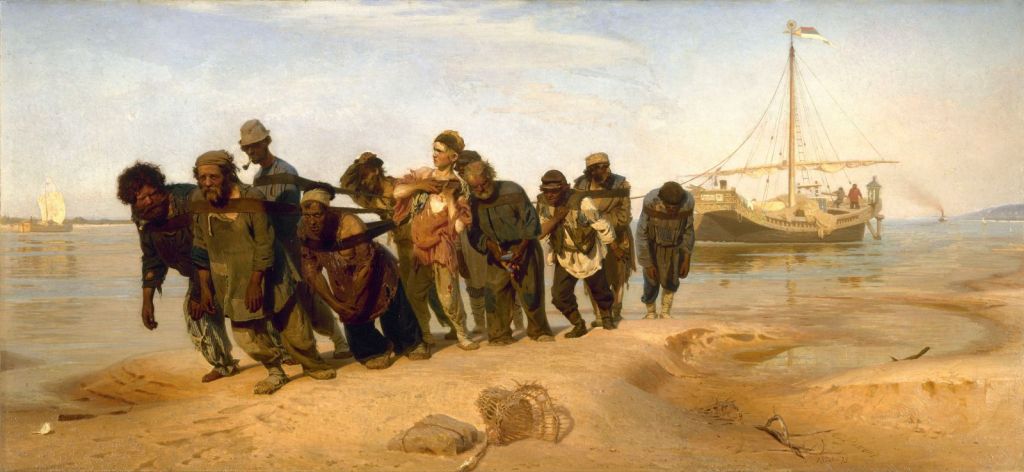
            In a sense, the beauty and value of an artwork lies outside its artistic value. One does not have to be a connoisseur of art to admire the suffering of the workers in Repin’s Barge Haulers of the Volga, or envy the revelry of his exuberant dancers in his Evening Party. On a deeper level, when we look at the colossal head of Constantine now in the Capitoline Museum, don’t we all think and reflect on the propagandistic use of art especially in the hands of dictatorial regimes, and how we should keep our eyes open to such manipulative tricks?

            Sometimes the messages artworks convey are accidental. When we look at the Parthenon our way of looking today is biased by its over two-thousand-year history; we think of the rape of its frieze by Lord Elgin, its devastation and near destruction at the Siege of the Acropolis, and by the general aura of myth associated with the 5th century BC world it epitomises. Its ruinous state tells us stories its original makers had never intended. And somehow, even despite all its tragedies, it makes it more powerful, poignant, even beautiful. In fact, if we were to see it in its heyday, full of painted friezes and with the giant statue of Athena stood before it, we might think it gaudy and tacky. A similar thing might be happening in our appreciation of Van Gogh. As undeniably great and revolutionary an artist as he was, in the popular mind especially, would he hold such sway on the public imagination without his well-documented mental troubles?

            As such, our definition of ‘beauty’ is partly independent of the physical work of art. Which is not to deny physicality as an essential ingredient for beauty. By such standards, most contemporary art, so bogged down by zeitgeist politics as they are, would be judged far more beautiful than, say, the seemingly apolitical, silent, carpet still-lifes of Francesco Noletti. But we all know this isn’t true. Any painting of Noletti is far more beautiful and eloquent than an installation by Tracy Emin. Message and dialogue alone does not make a work of art beautiful. Guernica would have been a far less powerful, grappling work of art if it was merely a blank canvas.

            Thus beauty in art is the interplay between the physical and the human; the timeless and the historic. An art historian’s role is to engage all of us, not just his or her fellow academics, in this all-too-human dialogue. After he has done all the hard work in analysing the historical background of a painting and gone into its formalities, he must then turn to the public and say, right, this artwork is saying XYZ about human nature, politics, religion, existence, purpose… what do you think about what it is saying?
Art as a revelation of human nature

What is the currency, the ultimate goal of the art historian when he looks back at the art of the past? Is it simply to explain art, to engage with beauty, to come to a definition of beauty? I don’t think art history as a discipline has one unifying aim, but rather it is split into the branching aims of its individual and philosophies.

            Yet ultimately, what all art historians engage in is a dialogue with the art of the past, starting from their present vantage point. All art historians are ambassadors of the present. None of them can exculpate themselves from the consciousness of the now. Some are more candid than others about their dependency on the present, more admitting of the subjectivity of the period they happen to be writing from.

            And why should we hide it? Whilst history is noble enough in and of itself, it has a higher aim: it must contain lessons – never direct nor deliberate – that we can debate and absorb for the sake of contemporary civilisation.

            Engaging with art history is to engage in the mind-sets, lessons, passions and philosophies of brother and sister human beings across time. Ultimately, human nature doesn’t change, but its circumstances does, wildly so. An art historian must use the art of a time to strip away the alien accretions of the age to pierce through the universal humanity underneath. We may no longer be as devout as in Michelangelo’s time, but what mother, in any historical epoch, could not relate to the suffering of the Virgin as she holds the body of her dead child in her arms? What of Ukrainians today, can they not relate to the unspeakable horrors described in Picasso’s Guernica just because they are being bombed by Russian planes instead of German ones and themselves exist in a different culture and country than 1930s Spain?

            In a sense, the beauty and value of an artwork lies outside its artistic value. One does not have to be a connoisseur of art to admire the suffering of the workers in Repin’s Barge Haulers of the Volga, or envy the revelry of his exuberant dancers in his Evening Party. On a deeper level, when we look at the colossal head of Constantine now in the Capitoline Museum, don’t we all think and reflect on the propagandistic use of art especially in the hands of dictatorial regimes, and how we should keep our eyes open to such manipulative tricks?

            Sometimes the messages artworks convey are accidental. When we look at the Parthenon our way of looking today is biased by its over two-thousand-year history; we think of the rape of its frieze by Lord Elgin, its devastation and near destruction at the Siege of the Acropolis, and by the general aura of myth associated with the 5th century BC world it epitomises. Its ruinous state tells us stories its original makers had never intended. And somehow, even despite all its tragedies, it makes it more powerful, poignant, even beautiful. In fact, if we were to see it in its heyday, full of painted friezes and with the giant statue of Athena stood before it, we might think it gaudy and tacky. A similar thing might be happening in our appreciation of Van Gogh. As undeniably great and revolutionary an artist as he was, in the popular mind especially, would he hold such sway on the public imagination without his well-documented mental troubles?

            As such, our definition of ‘beauty’ is partly independent of the physical work of art. Which is not to deny physicality as an essential ingredient for beauty. By such standards, most contemporary art, so bogged down by zeitgeist politics as they are, would be judged far more beautiful than, say, the seemingly apolitical, silent, carpet still-lifes of Francesco Noletti. But we all know this isn’t true. Any painting of Noletti is far more beautiful and eloquent than an installation by Tracy Emin. Message and dialogue alone does not make a work of art beautiful. Guernica would have been a far less powerful, grappling work of art if it was merely a blank canvas.

            Thus beauty in art is the interplay between the physical and the human; the timeless and the historic. An art historian’s role is to engage all of us, not just his or her fellow academics, in this all-too-human dialogue. After he has done all the hard work in analysing the historical background of a painting and gone into its formalities, he must then turn to the public and say, right, this artwork is saying XYZ about human nature, politics, religion, existence, purpose… what do you think about what it is saying?
today marks a new beginning

Today marks the beginning of a new week and a new season, and my mind is ablaze with the rush of a season marked by sunshine and new growth. As such, A New Beginning: Celebrating the Spring Equinox  sounded alluring.

A New Beginning starts by describing what exactly an equinox is. As an adult who somehow never stopped to picture why the solstices and equinoxes are the way they are, I appreciated the delightful illustrations and simple explanations. My favorite part, however, is the cultural celebrations that follow.

The second half of the book spends pages describing how different cultures, from ancient Persia to the Mayans to Israelites to modern Christians celebrate the return of spring. The pictures are vivid and engaging. The traditions described are not only fun, but also delve into the history behind why they became traditions. Plus, there are some fun crafts and recipes in the back!

I love spring. I love learning about other cultures. I love books that engage my toddler. A New Beginning hits the mark on all points.

swim for your life

Readers,

I wrote this short story one desperate day. Mental health had been a real struggle in The Gurney house and I was only starting to notice when it all spilled out over the last two years. In my grief, I found such strength in vulnerable and honest stories from others. While I am still struggling, I’ve wrestled enough with it in my own soul that I’m ready to write. This short story is for all those who are struggling with mental health. In some ways, it’s even more for the caretakers and partners who love their people enough to swim beside them. 

Swim  

I told everyone we were just going for a swim. A beach vacation desired by so many. It’s full of Instagram worthy moments with the sun setting over the water. 

Before we knew it, the sun was gone and the ocean went dark. How had the light gone so quickly? Why didn’t we notice the danger looming? But it is dark now, the waves smashing and crashing. “We are strong, especially you”, I tell myself believing we have everything inside ourselves to keep swimming. This is still vacation, after all, we can make this fun, plaster smiles across our faces, turn this night swim into an adventure. “It will be a good story to tell.” I am so good at finding the positive. 

Time drags and I’m no longer swimming but treading water. You shout to me for help and a tone of anger travels across the water. The ocean hears aggression but I hear something different. That’s what panic and fear sound like from your mouth.  

I reach out a hand to share my strength. “We can do this together, my love. We have always carried each other and always will.” Gradually we are not holding hands anymore. Bobbing above the waves you have moved to my shoulders and back desperately seeking relief. I am small but I’ve always held you. My back is stronger than it looks and my legs kick harder to hold us both afloat, but then you stop kicking altogether. 

A faint breeze moves the cloud cover and light from the moon shines on a boat we have not seen before. Was it always there? How did I not see it before? 

 “This is what we’ve been waiting for”, I tell you as I start swimming toward safety, sure you will follow me.  

Yet, you are doubtful and filled with worry. “Maybe the boat has holes. It could be going in the wrong direction,” you say with wide eyes. 

“It’s worth a try”, I say, pleading “We can’t swim much longer.” 

“It’s a bad idea, the boat might cost money I can’t repay.  If we row in on that boat, people will believe I wasn’t strong enough to swim. I can do this on my own.” you declare with finality frozen to this place in the ocean, hanging on to me as we both begin to sink. My mouth, then nose, and whole head go under as the air in my lungs is stolen. 

I kick with everything I have and propel my arms through the water toward that boat. My voice hopeful yet desperate, “Follow me, I don’t want to go without you!” But I cannot make you swim and I don’t want to drown. 

In the boat I take my first deep breath healing my muscles and awakening my brain. Clarity comes and I know the boat is not a mistake. I row towards you showing you the safety of the boat but you still won’t get in. 

Tears run down my face as I begin to row away. To what I am rowing, I don’t really know but away from here is all I can manage. Maybe I can find help to bring back.  Maybe if I show you where to go you’ll follow. I turn the boat around and push towards the shore. We lock eyes and I refuse to blink, keeping sight of you, feeling the impossibility of leaving you behind. Song lyrics drift from my lips like a prayer sent across the waves- “ Swim, swim for your life.” 

ANXIETY

Anxiety isn’t crying all the time alone in your room. It’s being alone silently wishing you had more tears to cry. Wondering why me? Why am I so broken? Why does no one see I’m suffering? It’s drowning in myself. It’s getting lost in all my cracks and flaws as I look in the mirror. It’s overwhelming fear when there isn’t a thing to fear. It’s being nervous and feeling your heart speed up as you enter a room. It’s feeling pressure in your chest as you walk out the door. It’s the fear you get on Sunday nights knowing when you wake up they’ll be school. It’s knowing when you wake up they’ll be school. It’s knowing no matter how many times you try to explain it, no one really gets it. It’s feeling so alone you shut your self off from everyone. It’s wanting to scream but not being able to even whisper a word. It’s being up all night being afraid of tomorrow and all the unknown. It’s being so broken you become numb. It’s making yourself physically sick. It’s panic attacks in public that you can’t control. It’s feeling nauseous just thinking about it. It’s not being hungry. It’s being exhausted all the time. It’s shaking but not being cold. It’s all of the above and so much more. It’s part of me. It’s consuming me.

Bundesliga match abandoned after beer hit assistant referee’s head

The Bundesliga match between Bochum and Borussia Moenchengladbach was abandoned on Friday after the assistant referee was struck on the head by a beer cup thrown from the stands.

Gladbach had been leading 2-0 at Bochum following second half goals from Alassane Plea and Breel Embolo when the match was interrupted after 71 minutes when linesman Christian Gittelmann took a blow to the head.

The referee took the decision to stop the game for good after 20 minutes.  

Both clubs immediately took to social media to condemn the incident.

“We can only formally apologise to linesman Christian Gittelmann,” Bochum said on social media. 

A  highly embarrassing and bitter evening for us. An extremely stupid action from an idiotic fan.”

Gladbach sporting director Roland Virkus added: “Things like this should never happen. It angers you when a good game of football has to end like this.”

where truly is home?

There is a popular saying that home is where the heart is. If you ask some people, they’ll tell you that home is where your life investments are. Some hold the strong opinion that home is where you were born while others believe that where you feel safe and at peace is home. There are many others who posit that where you are grandly celebrated and not just tolerated is a place to call home. Don’t these all make sense? But where, truly, is home? A young man I was when I chose to leave Nigeria to live in the US. America was a land unknown to me. It was a strange space. But I opted for the unknown and the strange. Spanning over three decades, the unknown became familiar. It became a home. It became a land I love. It became a land that rejiggered my destiny. A place that rewarded my hard work spanning over years. A place that hauled at me opportunities that were rare finds in my own country. Now, the strange land is where my three boys know as home. The only place, dear to their hearts. The only place in their calculations and preparations for the future.

But why have many Nigerians refused to call Nigeria home after they emigrate abroad? Why did they shake the dust off their feet at the departure point of Nigeria?  Why did many of our beloved cut off links with their country when they settled overseas? Well, everybody’s experience with home is different. If you are often immersed in the good side of Nigeria, Nigeria is good and Nigeria is home. If you frequently taste the ugly, wrecking, and killing side of the country, any other escape route becomes your home even if you have to do dirty jobs and slave off on menial salaried assignments for a living in a strange land.

Let me give you a peep into this truth. Nigerians, who live abroad, have this ravishing urge to return home to live. It’s an undying feeling. But the thought of returning home, especially in these times and seasons, is also unnerving. The insecurity is unnerving. The hunger and poverty you see on the faces of hapless Nigerians are unnerving. The business and economic climate swinging like yo-yo are unnerving. Just like Nigerians at home, those abroad are also disgusted about the state of the nation. The picture is not encouraging. Nigerians doing well abroad in many career fields get the motivational clarion call: “Come back home and let’s rebuild Nigeria. We need you. We want your expertise and experience.”  But in the last ten years, a few of my friends who responded to the call have been killed. Five were in a close shave with the Grim Reaper. If you’re not kidnapped, you are duped or robbed. A friend on a visit to Nigeria told me a few days ago that since he touched down about two weeks ago, darkness had enveloped the nation with no power supply. At gas stations, the price of petrol has gone through the roof and petroleum products are mostly unavailable. He said he had difficulty sleeping at night because there was no light to power the air conditioner that’ll help ease the pangs of the burning weather. He wondered how Nigerians survive the pervasive pain. And you wonder why many run when they can? Home is a place you find respite and rest. But if a place you call home cannot provide the essentialities of life, human beings are pushed to find them somewhere else. It is the law of nature. Legendary poet, Maya Angelou, poked my spirit with the word she once wrote, “The ache for home lives in all of us, the safe place where we can go as we are and not be questioned.”Home aches in you because it is safe to be called home. I will not blame those who have decided to call other places their home. To each his own.

The hearts of many people who travel abroad never left their home. They set for themselves a time frame to sojourn outside and return to where their hearts are. For them, a strange land is only a bus stop, not the destination. You must know when you are at a bus stop and when you head out to your destination. It was the story of a young man who travelled out from Lagos to Ukraine in 2000 in pursuit of a university degree. He resided in Kyiv for four years and after graduation, he attempted to leave for California. He didn’t get an entry visa into the US and instead headed out to the UK. He worked in the UK for another five years, made good money, connected with a few business merchants and then returned to Lagos. This was before the current war in Ukraine. Today, he is who Nigerians will call ‘a big boy’  in the country. I read his story recently in the aftermath of the Russian invasion of Ukraine, “Even if I had gotten the visa to go to California from Kyiv, I knew it would have been a bus stop.  Anywhere out of Nigeria is a bus stop for me. Nigeria is my destination, and God has blessed me here.” That was the young man’s submission.

For those who have made their final call never to return to their home nations, I feel you. But think about the blowback on foreigners after Russia’s recent invasion of Ukraine. Consider the massive surge for refuge in neighbouring countries unfriendly to black people and the inhumane treatments meted out to them. Within 24 hours of the Russian assault, affluent and rich foreigners living in palaces became homeless. The rich became poor. The employed became unemployed. Ask the big Nigerian pastor who made Ukraine home for forty years. Sunday Adelaja said some things that should make the wise think deeply. He had so much in a foreign land but he had to leave them all behind to live.  “I may never see my church and people again,” he said. Now he is in a hideout in a European country. Going back to his home country Nigeria is not an option. He has nothing much to lean on at home. What happened in Ukraine can happen anywhere in any nation of the world where you are considered an alien in spite of your long stay there.

Where one calls home is an individual judgement call. I am not ashamed to enlist in the platoon, which believes that home is where I was born, where I learned to crawl and mastered the art of walking; where I belched out my first hoot and coos as a baby and where the roots of my extended family are firmly established. For me, truth finds its resting place in my affirmation that Nigeria is sweet home. Home may be tough and rough today but a beautiful tomorrow can change the entire perspective and dynamic; don’t you believe that? I do! And I hope and pray. Amen!